
Introduction
Türkiye is a major European producer of European seabass (Dicentrarchus labrax), gilthead seabream (Sparus aurata), and rainbow trout (Oncorhynchus mykiss) (FAO 2022). The striped seabream, Lithognathus mormyrus, has been investigated in hatchery-related studies, including descriptions of its embryonic and yolk-sac larval development (Fırat et al. 2005). The species is widely distributed in the Mediterranean Sea, Black Sea, and eastern Atlantic Ocean (Froese and Pauly 2024), and is commonly found along the coastal waters of Türkiye, including both the Black Sea (Karadurmuş and Aydın 2022) and the Mediterranean basin.
Parasitic diseases represent one of the major constraints in marine aquaculture, affecting farm production, fish health, and economic viability, and in severe cases causing stock losses and mortality (Ogawa 2015; Shinn et al. 2015). Among these, polyopisthocotylean parasites of the family Microcotylidae are of particular concern due to their direct life cycles, high transmission potential, and capacity to proliferate under intensive farming conditions (Nowak 2007). Microcotylids are widely recognized as important gill pathogens of marine fish, especially within the Sparidae. For instance, Sparicotyle chrysophrii is a well-documented parasite of Sparus aurata, causing anemia, respiratory distress, and significant production losses in Mediterranean aquaculture (Alvarez-Pellitero 2004; Sitjà-Bobadilla et al. 2006). Similar infections have been reported in other sparid species (Faisal and Imam 1990), highlighting the potential risk that microcotylid parasites may pose to emerging aquaculture candidates such as L. mormyrus.
The family Microcotylidae Taschenberg, 1879 is one of the most diverse groups within the order Mazocraeidea. While Y. L. Mamaev (1986) listed approximately 150 described species across more than 40 genera, subsequent taxonomic revisions have considerably expanded this number, and current estimates suggest over 200 species distributed across more than 50 genera (Rohde 2005). These parasites exhibit a high degree of host specificity but may also display ecological plasticity under changing environmental conditions, particularly in aquaculture systems where host density is elevated (Nowak 2007).
Despite the ecological and economic importance of L. mormyrus, information on its parasite fauna in Turkish waters remains limited. In particular, no confirmed record of B. mormyri is available from Türkiye, and regional data on its occurrence and infection parameters are lacking.
Accordingly, the present study aimed to document the first confirmed geographical occurrence of B. mormyri in Türkiye, based on specimens collected from its type host, L. mormyrus, in Mersin Bay, and to provide baseline data on prevalence, intensity, and seasonal occurrence.
Materials and Methods
Fish sampling and handling
A total of 208 striped seabream were obtained from commercial fishermen operating in Mersin Bay (northeastern Mediterranean Sea, 36°47’N, 34°38’E) between February 2022 and December 2022. January 2022 was excluded from the sampling period due to the temporary suspension of commercial fishing operations in the region, which prevented the procurement of sufficient specimens. Fish originated from commercial catches and were already dead at the time of sampling. To minimize post-mortem degradation and prevent parasite detachment, specimens were transported to the laboratory in insulated containers with ice packs, maintaining a temperature of approximately 4 °C, and all fish were processed within 6–8 hours after capture. It is acknowledged that sampling of recently deceased fish may introduce a source of bias, as monogenean parasites, including microcotylids, may detach from gill tissues following host death (Kearn 1998; Whittington and Chisholm 2008). This limitation is discussed further in relation to the interpretation of negative findings.
Parasitological examination
Parasitological examinations were conducted at the Fish Diseases Laboratory, Faculty of Fisheries, Mersin University. For each fish, sex, total length (cm), and total weight (g) were recorded prior to examination. External surfaces, fins, and gills were systematically examined using a stereomicroscope (Olympus SZ61, Japan). Gill arches were excised and examined fresh in seawater under incident light for the detection of microcotylid gill parasites. The present study focused specifically on gill parasites.
Parasite collection and preparation
Parasites were carefully removed from gill filaments using fine needles and fixed in 70% ethanol. For permanent preparations, selected specimens were stained with acetic carmine, dehydrated through a graded ethanol series (70%, 80%, 90%, 96%, 100%), cleared in xylene, and mounted in Canada balsam. Additional specimens were cleared in glycerin ammonium picrate (GAP) solution for examination of internal structures. Morphometric measurements were performed after fixation using a calibrated ocular micrometer attached to a compound microscope (Olympus CX43, Japan). Photomicrographs of fresh and mounted specimens were obtained using a digital camera attached to the compound microscope. Each camera–objective combination was calibrated individually using a stage micrometer, and scale bars were generated for each image. Images were cropped proportionally, and adjustments to brightness and contrast were applied uniformly across the entire image. Clamp measurements were taken only from clamps lying approximately flat in face view, and egg dimensions were measured excluding the bipolar filaments. Unless otherwise stated, all measurements are given in micrometres (µm) as ranges followed by means in parentheses.
Identification and terminology
The parasites were identified based on morphological characteristics using standard taxonomic keys and original species descriptions. Morphological terminology follows MacCallum (1913), Euzet and Suriano (1977), Yu. L. Mamaev (1984; Y. L. Mamaev 1986), Radujkovic and Euzet (1989), and Costello (2001). The species was originally described as Microcotyle mormyri by Lorenz (1878) and subsequently transferred to the genus Bychowskicotyla by Unnithan (1971). A detailed redescription was later provided by Euzet and Suriano (1977). The nomenclatural and taxonomic status of this species is discussed further in the Discussion section. Scientific and common names of fish species follow Froese and Pauly (2024).
Parasitological Indices and statistical analysis
Parasitological indices, including prevalence (%) and mean intensity, were calculated according to Bush et al. (1997). Prevalence values were expressed with 95% confidence intervals (CI), calculated using the Wilson score method. Monthly prevalence estimates are presented with corresponding 95% CIs to account for variation in sample size among months. Differences in prevalence between the warm period (April–October) and the cool period (November–March) were assessed using Fisher’s exact test (α = 0.05). Quantitative results are expressed as mean ± standard deviation (SD), unless otherwise stated.
Results
A total of 208 L. mormyrus specimens collected from Mersin Bay between February 2022 and December 2022 were examined for gill parasites. B. mormyri was detected in 13 fish, with a total of 25 parasite specimens collected.
The overall prevalence was 6.25% (95% CI: 3.4–10.4), and the mean intensity was 1.92 ± 1.04 parasites per infected host (range: 1–4). No other microcotylid species were observed in the examined material. Infections were recorded exclusively between April and October, with no parasites detected during the remaining months. The highest monthly prevalence was recorded in August (25.0%; 95% CI: 4.6–64.2); however, this estimate should be interpreted with considerable caution given the small sample size for that month (n = 8). The highest mean intensity was observed in July (3.5 parasites per infected host; range 3–4). It should be noted that monthly sample sizes varied considerably (range: 8–24 fish per month), which may affect the reliability of individual monthly prevalence estimates; months with smaller sample sizes (August: n = 8; December: n = 8) yield substantially wider confidence intervals, as shown in Table 1. Overall infection levels remained low, and no visible pathological lesions were observed on the gill tissues of infected fish upon gross examination. Parasites were found attached to the gill filaments without a clear preference for specific gill arches. As all fish were examined post mortem, negative findings should be interpreted cautiously, as some parasites may have detached from the gills prior to examination. Monthly infection parameters are presented in Table 1.
Sampling months were grouped into the warm period (April–October; n = 145 fish examined) and the cool period (November–March; n = 63 fish examined). Infection was detected exclusively during the warm period, whereas no parasites were recorded during the cool period. Fisher’s exact test indicated a statistically significant difference in infection occurrence between periods (p = 0.011; two-tailed), a result consistent with a possible seasonal pattern; however, this finding must be interpreted with caution given the single-year sampling design, the unequal group sizes (warm period: n = 145; cool period: n = 63), and the complete absence of January data.
Bychowskicotyla mormyri (Lorenz 1878) Unnithan 1971
Family: Microcotylidae Taschenberg, 1879
Type host: Lithognathus mormyrus (Linnaeus, 1758)
Site on host: Gills (primary lamellae)
Locality: Mersin Bay, northeastern Mediterranean Sea, Türkiye (36°47’N, 34°38’E)
Material examined: A total of 25 adult specimens were collected; 16 specimens were deposited in the Museum of the Faculty of Fisheries, Mersin University (Museum no. MEUMMC-22-11-001); the remaining specimens were retained in 70% ethanol in the author’s reference collection.
Morphological remarks
A total of 25 specimens of B. mormyri were collected from the gills of L. mormyrus. The following account is based on acetic carmine-stained permanent preparations and glycerin ammonium picrate (GAP)-cleared specimens and is intended as a morphological confirmation rather than a complete redescription.
Body. Elongate, 5200–7300 (6250) µm long and 600–1050 (820) µm wide at maximum width, widest at the level of the genital atrium (n=20).
Anterior end. Buccal suckers paired, 95–120 (108) µm in diameter (n = 15). Pharynx well developed, spherical to subspherical, 120–145 (133) µm in diameter. Oesophagus short, bifurcating near the genital atrium; intestinal caeca extending posteriorly (Figure 1a).
Genital atrium. 140–160 (150) µm in diameter and armed with two morphologically distinct groups of spines. The anterior group comprised 8–12 robust spines, 18–25 µm long, whereas the posterior spines, 8–12 µm long, were arranged in two approximately symmetrical lateral fields (Figure 1b).
Opisthaptor. Symmetrical and triangular in outline, bearing 80–100 pairs of clamps arranged in two longitudinal rows (Figure 1c). This range overlaps with the 84–96 pairs reported by Euzet and Suriano (1977) and the 85–98 pairs reported by Orecchia and Paggi (1983). Variation in clamp number likely reflects a combination of genuine interindividual variation and counting difficulty arising from partial overlap of clamps in mounted preparations. Individual clamps were bilaterally symmetrical and slightly longer than wide. Clamps measured 38–52 × 28–45 (45 × 36) µm ( n = 30 clamps from 10 specimens) (length × width) (Figure 1c). Terminal anchors were absent.
Reproductive system. Testes intercaecal, in posterior half of body, 18–24 in number. Ovary single, pretesticular. Vitelline follicles dense, extending laterally along most of the body length.
Eggs. Ovoid, 150–175 × 75–95 µm (n = 20 eggs from 8 specimens) (length × width; measurements excluding filaments), bearing long bipolar filaments, one of which terminates in a minute hook-like tip (Figure 1d). Minor variation in egg dimensions was observed and is interpreted as intraspecific variability.
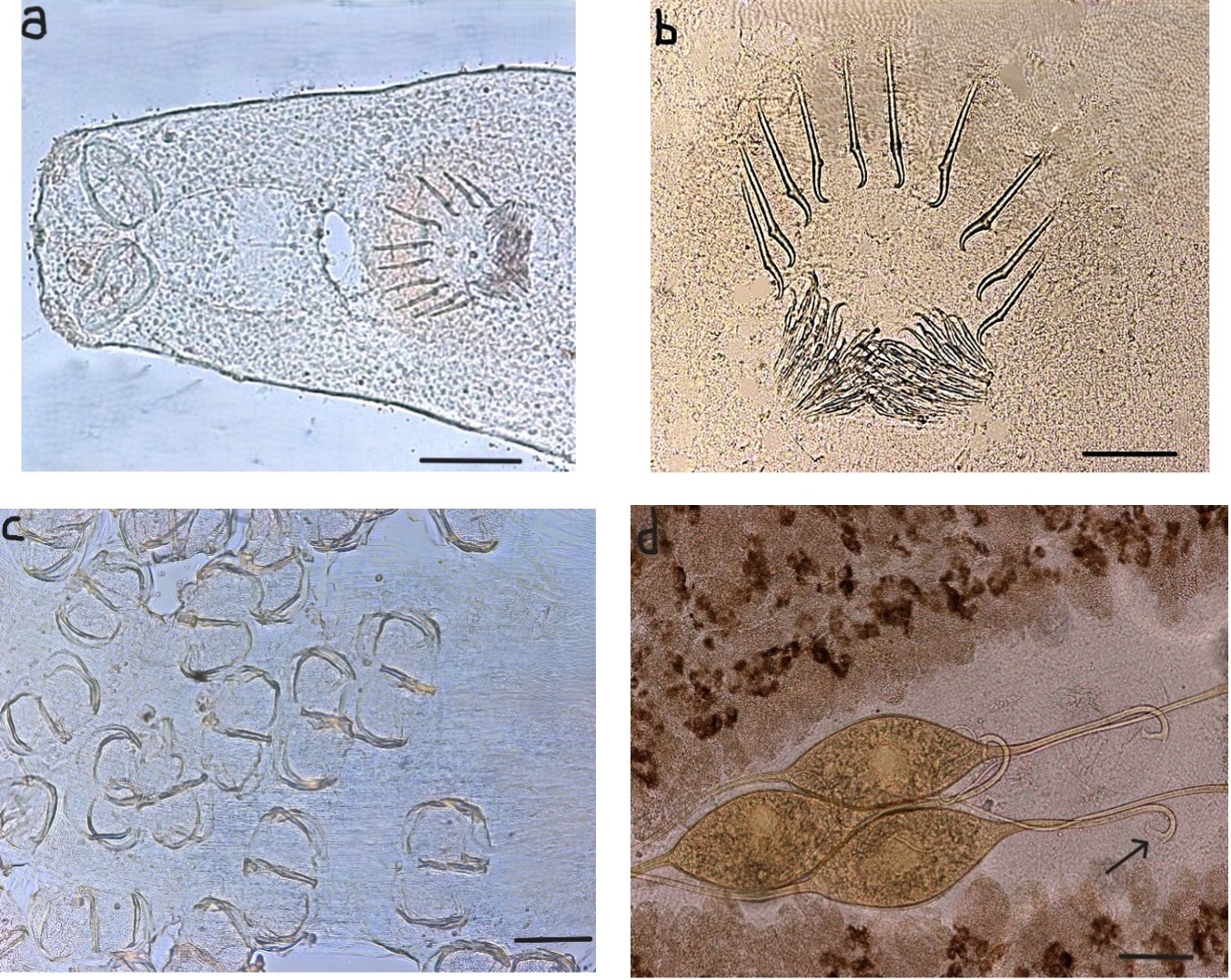
Overall. The specimens examined were consistent with previous descriptions of B. mormyri by Lorenz (1878), Euzet and Suriano (1977), and Orecchia and Paggi (1983). No additional diagnostic features were observed.
Discussion
This study documents B. mormyri from its type host, L. mormyrus, in Mersin Bay and represents the first confirmed geographical record of the parasite from Türkiye. It is not a new host record because L. mormyrus, historically also referred to as Pagellus mormyrus, is the host from which the parasite was originally described. Previous geographical records are restricted to other Mediterranean regions, including the Adriatic, central and western Mediterranean basins, and the southern coasts of Algeria and Libya (Gasmi 1999; Azzouz 2001; Hafir-Monsouri et al. 2017; Altikbali et al. 2024). The present finding therefore fills a geographical gap in the known Mediterranean distribution of the species.
The species examined in the present study is referred to as B. mormyri (Lorenz 1878) Unnithan 1971, following the nomenclature adopted by Euzet and Suriano (1977), Hafir-Monsouri et al. (2017), and Altikbali et al. (2024). It should be noted, however, that Orecchia and Paggi (1983) transferred this species to the genus Atrispinum, referring to it as Atrispinum mormyri (Lorenz 1878), and assigned it to the subfamily Atriasterinae. This reflects an unresolved nomenclatural discrepancy in the literature. The genus Atrispinum was distinguished from Bychowskicotyla primarily by the arrangement and form of the genital atrium spines (Orecchia and Paggi 1983; Yu. L. Mamaev 1984). In the specimens examined in the present study, the genital atrium bore two morphologically distinct groups of spines — a robust anterior arc and two symmetrical posterior fields — a configuration that falls within the range described for both genera and does not unambiguously resolve the nomenclatural question on morphological grounds alone. The name Bychowskicotyla mormyri is retained here in accordance with the majority usage in subsequent literature (Euzet and Suriano 1977; Radujkovic and Euzet 1989; Hafir-Monsouri et al. 2017; Altikbali et al. 2024). Because molecular data are not yet available for this species, its systematic position cannot presently be assessed independently, and future studies incorporating molecular markers are needed to clarify the taxonomic status of this taxon.
The morphology of the examined specimens is in full agreement with previous descriptions of B. mormyri. The species was originally described as Microcotyle mormyri by Lorenz (1878), transferred to Bychowskicotyla by Unnithan (1971), and subsequently redescribed by Euzet and Suriano (1977). Key features including body proportions, clamp number, testis count, and egg dimensions fall within the ranges reported in earlier studies (Euzet and Suriano 1977; Orecchia and Paggi 1983; Y. L. Mamaev 1986). Taxonomically relevant structures including the genital atrium armature and the opisthaptor configuration showed no deviation from the established pattern. Minor variation in egg size was observed but is interpreted as intraspecific variability (Y. L. Mamaev 1986). Overall, these observations support the morphological stability of B. mormyri across its distribution range. It should be acknowledged that species identification in the present study was based exclusively on morphological criteria. Molecular characterization, such as sequencing of the 28S rRNA or ITS1/ITS2 regions, was not performed. While the observed morphology is fully consistent with previous descriptions and supports the identification, molecular data would provide independent confirmation and enable phylogeographic comparisons across the Mediterranean. Future studies on this species are therefore encouraged to incorporate molecular markers to strengthen taxonomic conclusions.
The infection parameters recorded (prevalence 6.25%; mean intensity 1.92 ± 1.04) are within the range of values reported from other Mediterranean localities, although direct quantitative comparisons are difficult due to differences in sampling design, seasonal coverage, and sample sizes among studies (Gasmi 1999; Azzouz 2001; Hafir-Monsouri et al. 2017). Factors such as water temperature, salinity, host density, and host body condition are known to influence transmission dynamics in monogenean parasites and may account for observed geographic variation in infection parameters (Alvarez-Pellitero 2004; Shinn et al. 2015).
Infections were recorded exclusively during the warm period (April–October), with a statistically significant difference in occurrence between warm and cool periods (Fisher’s exact test, p = 0.011). This seasonal pattern is consistent with the biology of monogenean parasites, whose transmission and development are significantly influenced by environmental conditions, particularly temperature. Higher temperatures are known to accelerate life cycle processes such as egg hatching and larval development (Ernst et al. 2002; Ogawa 2015). Sea surface temperatures in Mersin Bay typically range from approximately 15 °C in winter to over 28 °C in summer (Sert and Akçaalan 2018). The absence of detected infections during cooler months may suggest that lower temperatures constrain parasite survival or reduce oncomiracidium viability. It must be noted, however, that these seasonal observations are based on a single annual sampling cycle. Inter-annual variation driven by climate fluctuations, anomalous sea surface temperatures, or changes in host population structure could produce different patterns in other years. The data presented here should therefore be interpreted as a preliminary observation rather than a definitive characterization of seasonal dynamics, and multi-year monitoring will be required to confirm and generalize these findings.
An absence of preference for specific gill arches was observed in the present study. This contrasts with the behaviour reported for some microcotylid species, which show consistent preferences for particular arch positions (Rohde 1993). The biological significance of this neutral distribution in B. mormyri is unclear; it may reflect low infection intensity, which would reduce inter-parasite competition for attachment sites, or it may represent a genuine lack of site specificity in this species. Further studies with higher sample sizes and broader intensity ranges would be needed to evaluate this.
Although the infection levels observed in wild fish were low, B. mormyri may warrant inclusion in future parasite surveillance programmes for L. mormyrus. High host density and persistently favourable temperatures can facilitate the transmission of directly transmitted monogeneans in aquaculture systems, as reported for related microcotylids (Faisal and Imam 1990; Sitjà-Bobadilla et al. 2006; Nowak 2007). However, the present study did not examine cultured fish or transmission between wild and cultured populations and therefore does not demonstrate a reservoir role for wild L. mormyrus. It establishes only the occurrence of the parasite in wild fish from Mersin Bay.
An important methodological limitation of the present study concerns the use of fish obtained from commercial catches. Although specimens were transported under refrigeration and processed within 6–8 hours of capture, monogenean parasites are known to begin detaching from gill tissue following host death (Kearn 1998; Whittington and Chisholm 2008). This means that prevalence and intensity values reported here may represent underestimates of true infection levels, and absence of infection in negative fish cannot be interpreted with the same confidence as in studies using live-sampled animals. This limitation is particularly relevant when interpreting the apparent absence of infection during cooler months and the observed monthly variation in prevalence. Future studies should ideally incorporate live-sampled or freshly euthanized specimens to obtain more reliable quantitative data. Similarly, histological examination of gill tissue was not performed in the present study. This represents a limitation, as microscopic tissue responses such as lamellar fusion, epithelial hyperplasia, or inflammatory cell infiltration may occur even in the absence of gross pathological lesions, as documented for other gill monogeneans (Sitjà-Bobadilla et al. 2006). Histopathological analysis is recommended in future investigations to fully characterize the pathological significance of B. mormyri infections in this host.
Monogenean parasites have been reported from various marine and freshwater fish species in Turkish waters, including the Black Sea coast (Öztürk and Özer 2014) and the Aegean Sea (Akmırza 2013). Microcotylid monogeneans have previously been documented from marine fish species in Turkish waters, including representatives from sparid hosts (Genç 2011). however, B. mormyri specifically has not been recorded from any host in Turkish waters prior to the present study. Its detection therefore contributes to the known parasitological diversity of the northeastern Mediterranean and improves our understanding of the host–parasite fauna of L. mormyrus in this region.
In conclusion, this study provides the first confirmed geographical record of B. mormyri from Türkiye, based on specimens collected from its type host, L. mormyrus, in Mersin Bay. The infection data indicate an apparent concentration of records between April and October, but this pattern should be considered preliminary because sampling covered only one annual cycle and monthly sample sizes were unequal. Multi-year sampling, molecular characterization, and histopathological examination will be necessary to confirm seasonal patterns, clarify the systematic position of the parasite, and assess its pathological significance.
Consent to publish
Not applicable.
Ethical approval
All fish used in this study originated from commercial fishing catches and were already dead at the time of sampling. No live animals were handled or sacrificed specifically for the purposes of this research. Therefore, formal ethical approval was not required under current Turkish national legislation. Nevertheless, all procedures were conducted in accordance with applicable guidelines for the responsible conduct of research.
Declaration of interests
The author declares that he has no known competing financial interest or personal relationship that could have appeared to influence the work reported in this paper.